
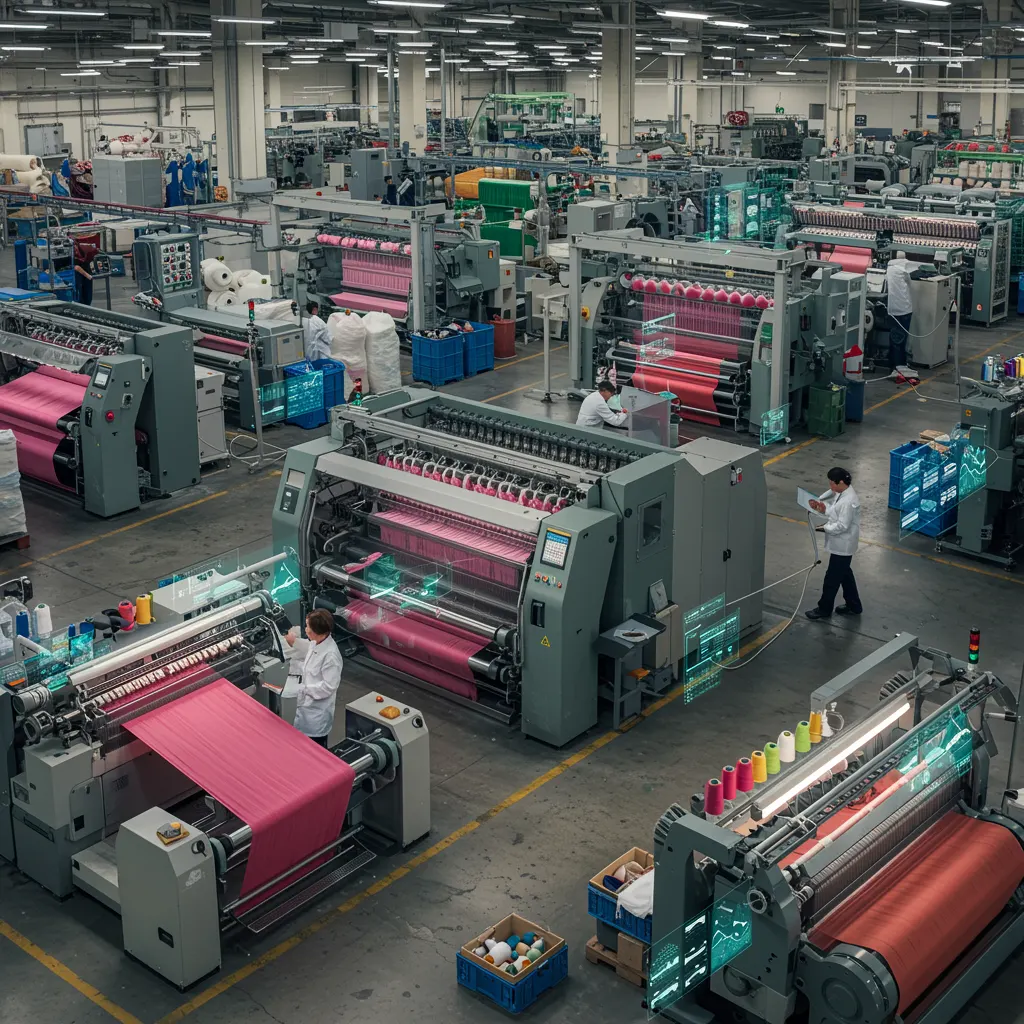

ERP for Textile Manufacturing
The textile industry operates within one of the most complex supply chains globally. From managing volatile raw material costs (yarn, fabric, and dyes) to coordinating multi-stage production cycles—spinning, weaving, dyeing, and finishing—the margin for error is razor-thin. Manual processes often lead to inventory silos, production bottlenecks, and significant material wastage.

Why Textile Manufacturers Need a Specialized ERP System
General manufacturing software often fails to account for the unique variables of the textile world. A dedicated textile manufacturing ERP software is essential for:
Multi-Stage Production Coordination
Seamlessly transitioning work-in-progress from spinning to weaving, & finally to dyeing & finishing.

Complex Batch & Lot Tracking
Maintaining precise records of dye lots and fabric batches to ensure color consistency.

Raw Material Price Fluctuations
Real-time updates on yarn and cotton prices to ensure your quotes remain profitable.

Waste Control
Monitoring “invisible loss” and scrap during the production process to protect your bottom line.

Production Planning
Balancing machine capacity with urgent client deadlines to prevent idle time.

Export Documentation
Automating the heavy paperwork required for international apparel trade & customs compliance.

Common Challenges Faced by Textile Manufacturers
Without a centralized ERP for textile mills, companies face systemic “leaks” that erode profitability. We solve these critical industry pain points:
High Raw Material Wastage
Unpredictable Production Delays
Inaccurate Demand Forecasting
Stock Overproduction
Color & Lot Traceability Issues
Quality Control Inconsistencies
Manual Costing Errors
Supply Chain Inefficiencies
Vendor Management Problems
Profit Margin Leakage
Delayed Financial Reporting
Closing the books takes weeks instead of days.
Poor Resource Utilization
High-value developers sitting “on the bench”.
30%
Increase in overall productivity
Common Challenges Faced by IT & Software Companies
Operating without a centralized ERP for IT services leads to systemic friction. We address these critical pain points:
High Raw Material Wastage
Unpredictable Production Delays
Manual Invoicing Struggles
Stock Overproduction
Color & Lot Traceability Issues
Quality Control Inconsistencies
Manual Costing Errors
Supply Chain Inefficiencies
Vendor Management Problems
Profit Margin Leakage
Delayed Financial Reporting
Closing the books takes weeks instead of days.
Poor Resource Utilization
High-value developers sitting “on the bench”.
30%
Increase in overall productivity
Powerful ERP Modules Designed for Textile Industry
Our Apparel manufacturing ERP system consists of interconnected modules tailored for the textile floor.
Production Planning & Control (PPC)
The brain of your manufacturing unit.

Raw Material Management
Gain total control over your warehouse.

Quality Control (QC) Management
Ensure perfection in every yard.

Sales & Order Management
From the showroom to the shipping container.

Finance & Costing
Precision financial management for high-volume manufacturing.

HR & Payroll
Manage your most valuable asset: your workforce.
Benefits of ERP for Textile Manufacturing Companies
Implementing a Fabric production ERP results in a leaner, more agile business:
25% Reduction in Wastage
Precision tracking of material consumption.
Increased Production Efficiency
Higher machine utilization through smart scheduling.
Real-Time Visibility
Access your mill’s data from anywhere in the world via the cloud.
Faster Order Fulfillment
Shorten lead times by eliminating manual communication gaps.
Accurate Costing
Price your products confidently with down-to-the-penny data.
Improved Quality Compliance
Meet the strict standards of global retail brands (e.g., ISO, Oeko-Tex).
Scalable Growth
Easily add new production lines or processing units to your digital network.
ROI Tracking
Delayed Financial Reporting
+25%
Year over Year
M1
M2
M3
M4
M5
M6
M7
| M1 | M2 | M3 | M4 | M5 | M6 | M7 |
Why Choose Pro ERP Solution?
We provide more than just software; we provide a foundation for your digital transformation.
Industry-Specific Customization
We understand “S to XXL” and “Warp & Weft”—our system is built for your terminology.
Cloud-Based Architecture
No expensive on-site servers; access your data securely on any device.
Multi-Plant Support
Consolidate data from spinning, weaving, and dyeing units into a single report.
24/7 Global Support
Our experts are available around the clock to ensure your machines never stop due to a software glitch.
How Our ERP Helps Textile Manufacturers Grow: Real-World Use Cases
| Scenario | The Challenge | The Pro ERP Result |
|---|---|---|
| Spinning Mill | Struggling with 15% cotton wastage and fluctuating yarn quality. | Reduced wastage by 20% through automated mixing ratios and batch tracking. |
| Garment Exporter | Managing 200+ active orders; frequent delays due to fabric shortages. | Improved order tracking by 40%, ensuring 100% on-time delivery for major retailers. |
| Dyeing Unit | Frequent rework due to color mismatch between batches. | Implemented strict lot-based QC, reducing re-dyeing costs by 35%. |

Frequently Asked Questions (FAQs)

What is ERP for textile manufacturing?
It is a specialized software suite designed to manage the unique production, inventory, and financial workflows of the textile industry, from fiber to finished fabric.
How does ERP help garment manufacturers?
It synchronizes the supply of fabric with the production schedule, tracks labor productivity, and ensures that garment sizes, colors, and styles are tracked accurately across orders.
Can ERP manage textile production planning?
Yes. Pro ERP Solution includes a Production Planning & Control (PPC) module that optimizes machine allocation and schedules batches based on delivery deadlines.
Is cloud ERP suitable for textile mills?
Absolutely. Cloud ERP allows mill owners to monitor multiple production facilities remotely, reduces IT infrastructure costs, and ensures data is backed up securely.
How does ERP reduce wastage in textile industry?
By providing precise “recipe” management for dyes, optimizing fabric cutting patterns, and tracking raw material consumption against output in real-time.
What modules are essential for textile ERP?
Key modules include Production Planning, Inventory (Lot/Batch tracking), Quality Control, Finance/Costing, and Sales/Export management.
How much does textile ERP software cost?
The cost varies based on the size of your operation and the number of modules required. We offer scalable pricing models for both small units and large textile conglomerates.
Transform Your Textile Manufacturing Business with Smart ERP
Stop the wastage. Start the growth.
In an era of fast fashion and global competition, textile manufacturers cannot afford to be slowed down by fragmented data and manual processes. Pro ERP Solution gives you the tools to modernize your mill, empower your workforce, and maximize your output.
