
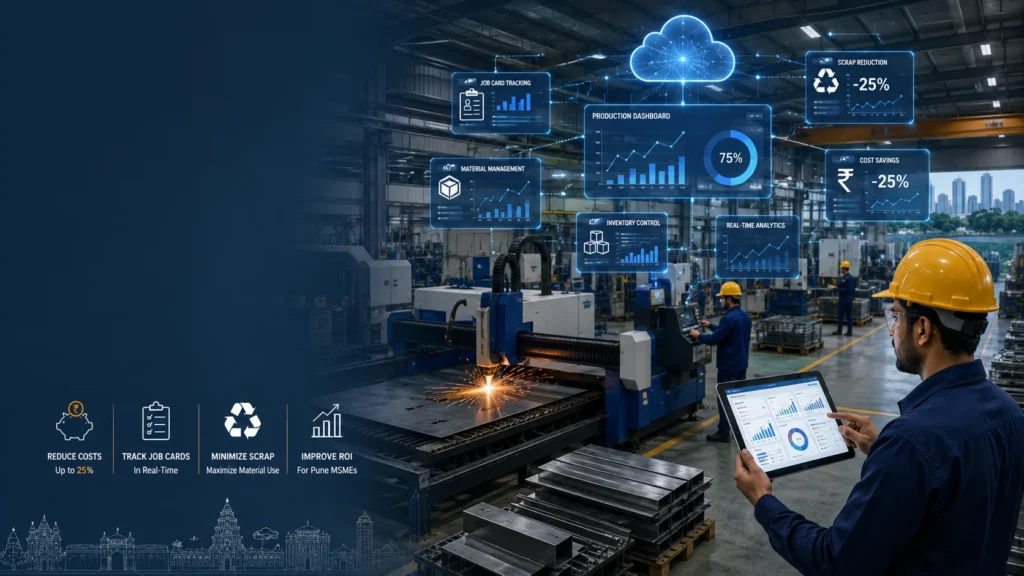
For engineering small-and-medium enterprises (MSMEs) spread across the industrial hubs of Bhosari, Chakan, and Pimpri-Chinchwad, thin margins are an ongoing challenge. With raw steel, aluminum, and fuel prices fluctuating constantly, traditional engineering workshops are discovering that tracking structural components on clipboards no longer protects profitability.
The core issue isn’t a lack of orders; it is operational leakage. From our experience on the ground, typical custom fabrication shops lose a substantial percentage of their net margins to three specific leaks: material scrap mismanagement, unmonitored job-card variations, and manual job work calculations (Challan tracking).
Transitioning to a dedicated cloud system changes these dynamics entirely. Let’s analyze how partnered workshops regularly achieve a 25% reduction in overall operational costs within a single fiscal year.
The Anatomy of a 25% Cost Reduction: Where the Savings Live
To understand the return on investment (ROI) of an implementation driven by a local erp software company in pune, we must break down the financial leaks that traditional spreadsheet systems overlook. Real cost control occurs across three specific areas:
1. Slashing Raw Material Scrap and Offcut Losses (Target: 8–12% Savings)
In heavy structural metal fabrication, steel plate and sheet inventory make up the vast majority of direct job expenses. When supervisors pull materials from inventory without tracking offcuts, those leftover pieces get buried in a corner of the shop floor.
A cloud ERP engineered for fabricators uses child-part serial tracking. When a laser or plasma cutting pattern uses 70% of a standard steel sheet, the system automatically logs the remaining 30% offcut as available inventory with distinct dimensions. The next time a smaller order comes in, the planning engine checks the offcut database first, keeping new sheets on the rack.
2. Elimination of Unbilled Design Scope Creep (Target: 5–7% Savings)
Custom engineering orders often undergo revisions. A client sends an updated CAD drawing requesting structural reinforcements mid-production. If the shop floor implements the change without logging the extra welding hours or thicker plates into an integrated costing sheet, those adjustments eat directly into your profits.
Cloud systems resolve this by linking your engineering BOM (Bill of Materials) directly to live production tracking. Any variation in gauge thickness or extra structural assembly time requires a system sign-off, automatically adjusting the final bill or prompting an immediate revision to the commercial quote.
3. Streamlined Job Work Compliance & Subcontracting (Target: 4–6% Savings)
Very few MSME fabricators handle every process under one roof. Components are regularly sent out to local specialists in Chakan or Bhosari for powder coating, hot-dip galvanizing, or specialized heat treatments. Relying on paper challans to track these movements often leads to misplaced parts and vendor payment disputes.
In Practice: Automating this process with localized software ensures that every outbound material movement generates an electronic Challan linked to the specific customer job card. The cloud system monitors delivery times, updates sub-assembly statuses automatically, and cross-checks the external vendor’s tax invoice against the original contract rates to prevent overbilling.
Financial Breakdown: Core On-Premise vs. Cloud ERP Overhead Costs
For an industrial workshop, choosing the right architecture impacts your monthly cash flow. Many owners assume that setting up local servers inside their office is the safest bet. The table below compares the actual cost profiles over a three-year lifecycle for a typical 25-user environment:
| Expense Category | Traditional On-Premise Architecture | Modern Cloud ERP Infrastructure |
| Upfront Infrastructure | High (Dedicated server hardware, UPS arrays, climate-controlled server closet). | Zero (Accessible instantly via secure web browsers and Android mobile apps). |
| IT Administrative Payroll | Requires dedicated onsite IT technicians for backups, patches, and network issues. | Managed entirely by the vendor’s cloud engineering team. |
| Data Safety & Protection | High risk of local hardware failure, local power surges, or site-level damage. | Automated, redundant backups across secure regional cloud servers. |
| Scalability Across Units | Requires complex VPN tunnels to link production spaces in Chakan and Bhosari. | Native multi-plant data syncing out of the box. |
The Step-by-Step Workshop Transition Roadmap
Deploying software in a high-activity environment requires a pragmatic rollout plan. Based on successful transitions across Maharashtra’s manufacturing belt, here is the optimal implementation path:
1.Isolate High-Waste Control Points: Phase 1.
Start by mapping where material losses are highest. For most fabrication shops, this means digitizing inventory inwarding and raw material tracking first.
2.Standardize Dynamic Job Cards: Phase 2.
Move away from open-ended descriptions. Build discrete digital job cards within the system that track specific cut, bend, weld, and finishing stages.
3.Train Operators Using Mobile UI: Phase 3.
Desktop interfaces fail on dirty fabrication floors. Equip supervisors with rugged mobile applications or tablets to log job completions right at their welding or cutting stations.
4.Connect Financial & GST Modules: Phase 4.
Once production data is accurate, bridge it with automated billing, inventory reorder points, job-work challan reconciliations, and local Indian GST reporting.
Strategic Long-Term Cost Savings and Evolving Industry Trends
Looking ahead, the benefits of modern cloud ERP systems extend well beyond tracking inventory. With the growth of regional infrastructure projects across western India, fabrication workshops face stricter quality audits and compliance mandates from large tier-1 corporate buyers.
Cloud platforms are rapidly evolving to integrate predictive tool-wear scheduling for expensive plasma nozzles and CNC tooling, automated carbon footprint reporting for export-oriented contracts, and instant digital material traceability chains. Embracing these data-driven habits early guarantees that your workshop remains competitive, highly responsive, and structurally profitable for years to come.
Frequently Asked Questions (FAQs)
Q1: How does a cloud ERP accurately calculate the cost of custom, one-off fabrication jobs?
A: Unlike mass-production software, a fabrication-focused cloud ERP uses dynamic job costing. It links actual raw material consumption (including specific plate thicknesses) and real-time labor hours logged via shop-floor tablets directly to the specific job card. This allows you to compare estimated engineering costs against true actual expenses instantly.
Q2: Can the ERP track steel plate offcuts so they don’t get lost on the shop floor?
A: Yes. In practice, when a sheet or plate is cut, the system prompts the operator to input the dimensions of the remaining material. The cloud ERP automatically lists this offcut as a “child-part” in your active inventory. When a new job requires a similar small profile, the system alerts planners to use the offcut rather than pulling a brand-new sheet from the rack.
Q3: How does the software handle job work sent to external vendors in Bhosari or Chakan?
A: The platform automates subcontracting by generating an electronic Job Work Challan (under local compliance rules like GST Challan 125) straight from the production module. It tracks exactly when the components left your facility, monitors the vendor’s processing turnaround time, and matches their invoice directly against the pre-agreed contract rate to prevent overbilling.
Q4: Will a cloud-based system work reliably if our workshop experiences internet fluctuations?
A: Modern cloud ERP systems built for industrial hubs feature offline data synchronization capabilities. Factory supervisors can continue logging production milestones, material issues, and time sheets on mobile apps or rugged tablets without an active connection; the data automatically syncs to the central cloud database the moment connectivity is restored.
Q5: What is the average timeline for an MSME fabrication workshop in Pune to see a full ROI?
A: From our experience with engineering workshops across Pimpri-Chinchwad, most units achieve a complete return on investment within 8 to 12 months post-implementation. This timeline is driven by immediate reductions in raw material waste, the elimination of unbilled design scope creep, and fewer manual clerical errors.
Plug the Leaks on Your Fabrication Floor
Stop guessing your actual job costs and material margins. Contact our localized engineering systems experts in Pune to run a structural cost-benefit analysis for your production unit.